

TU Logo Paint Branch River

Potomac-Patuxent Chapter Trout Unlimited


September

The next Monthly PPTU Meeting is Wednesday, September 15, 2010 at 7:00 PM.

Fall's Best Trout Fishing by Jay Sheppard (see Meetings for further details).

Trout in the Classroom expands to 21 schools in seven Maryland counties this school year. (see Trout in the Classroom for further details and Maryland DNR recognition).

Dave Wittman passed away on September 18, 2009. We have dedicated a page on our website at Dave Wittman's section.

The Annual Newsletter for 2010 is posted in the Annual Newsletter section!

The OUTING Report for the August Yellow Breeches outing is posted in the Outingssection!

Some shad fly patterns as well as several new patterns from the January 2010 Fly Tying Demonstrations are in the Fly Tying Section.

One on one stream side fly fishing instruction is available to PPTU members.

Go to the Mentor Program page for details.

Project Healing Waters
Fort George Meade

In September of 2009, volunteers from the Potomac Patuxent Chapter of Trout Unlimited (PPCTU), in conjunction with the Fort George Meade Warrior Transition Unit (WTU), held their first meeting of Project Healing Waters (PHW).

Our first class was attended by four wounded warriors and quickly expanded to more. Classes started with volunteers Jim Greco, Carl Smolka, Dennis Covert, me, and now include Harry Steiner, who joined us in January, with Rodger Carlson and Patty Nicholson joining us in May. Note: Dave Wittman also volunteered to help with PHW, however, he was taken from us just before the first meeting.


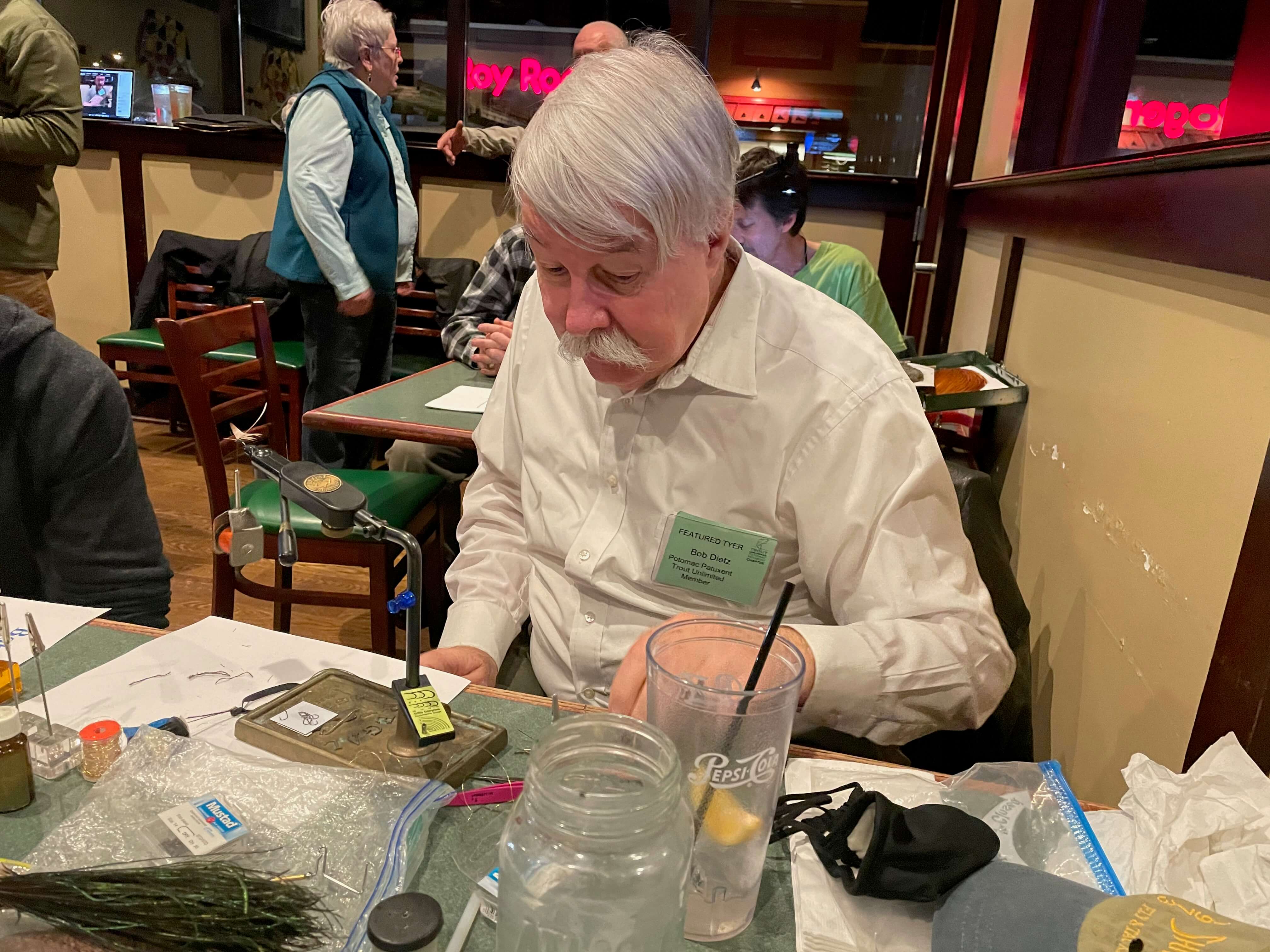
The Ft Meade Warriors watching Bob Dietz in action

RJ showing off a fly she just finished

There is plenty of clowning around

Our warriors getting down to business with Jim Greco

A little one on one with Harry Steiner

Rochelle tying another excellent fly

Every Thursday evening, from 7:00 PM until 9:00 PM, PPCTU volunteers meet with the wounded warriors to share their knowledge of fly tying, casting, knot tying, and trout fishing.

This spring, PPCTU sponsored a PHW outing for our warriors to Burba Lake at Fort Meade. Our wounded warriors enjoyed catching bluegills and bass on flies they had tied. Laughs and shouts of encouragement were heard all around the lake. After fishing, the warriors and volunteers enjoyed a shore lunch of grilled burgers and hot dogs.


John bring one in

RJ my fish is bigger than your fish !

RJ with one of her many

Jerry working the spawning beds . That's Tom in the back ground working the deeper waters

John stowing the gear

I believe I can speak for all the volunteers when I say this program has been a very rewarding experience. I cannot remember ever feeling so good about giving a little time, and what a great way for us to be able to thank those who have given so much for us. This is the least we can do to say thanks, and it is personally very rewarding.

Thanks to all of the warriors who serve our country.

Larry Vawter

John Hopkins Outdoor Club Outing 9/2009

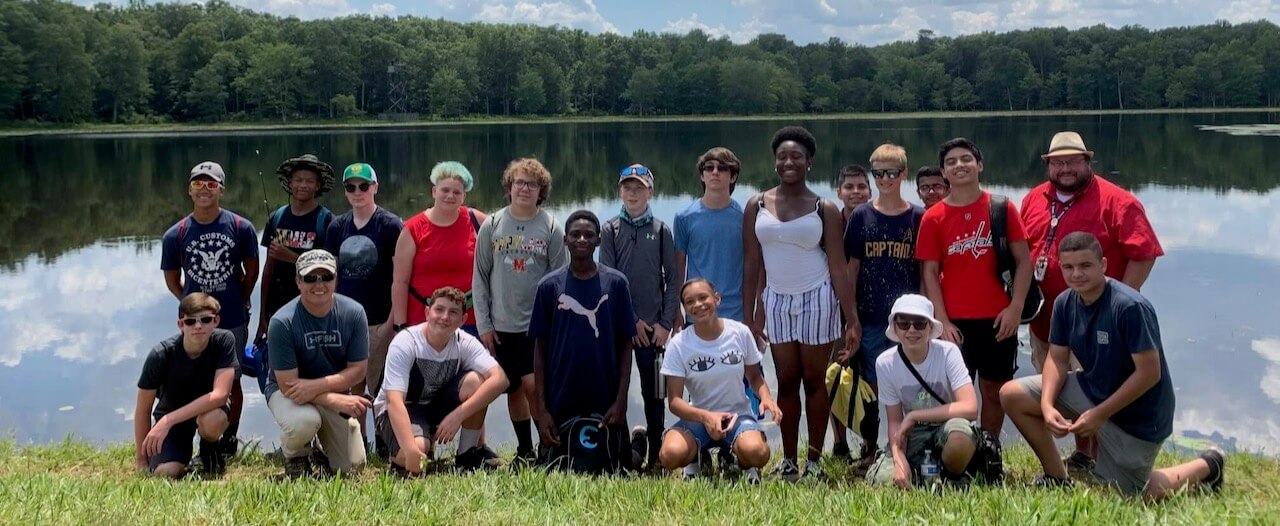
On Sunday, September 26, 2009, we had arranged to take the Johns Hopkins Outdoors Club fly fishing in the Potomac for smallmouth. I spent most of Saturday checking the USGS flow gauge, since it was raining heavily. The weather reports didn't look very promising either; several predicted thunderstorms and 20+ mph winds. Things looked a bit better when I got up on Sunday, the river hadn't risen, and the weather prediction now said 20% chance of light showers. Still, driving to the river in a constant "light shower", I wondered if anyone else was going to show up. I was pleasantlty surprised to see when I got there (ten minutes before our scheduled meeting time) that eight Hopkins students were already there, along with Carl Smolka and Grant Faller. With the addition of my son and myself, we had a one-to-two ratio of PPTU people to students, which worked out nicely. It also stopped raining, which was also nice.

The river was LOW. In spite of a day of rains, it was flowing at about 1500 cfs, considerably lower than the 2800 cfs we experienced last year, and it was low then.

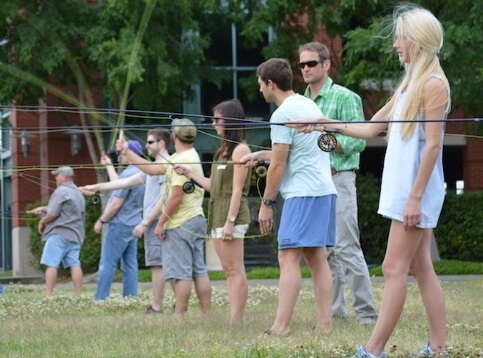
After some preilimary cast instruction and practice, we hit the river. Wading was very easy; I never got my belt wet, and I pretty much waded from bank to bank. None of the students had any problems wading. Carl didn't even get his camera wet.

That was the good part of the low flow. The bad part was that the heavily weighted flies we had come prepared with were just about useless. Above the bridge, where we spent the morning, the weed beds extended across the whole river, and from top to bottom. The poppers I tied proved to be a bit too wind resistant for the five weight rods we had given the students to use, so no body was catching any fish. I did manage one sunfish from a weed free hole three quarters of the way across the river. A flock of spin fishermen immediately rushed for the spot when they saw me with a fish.

(Notice I said "sunfish", not bluegill. The native sunfish of the Potomac is actually the red-breasted sunfish, and I'm trying to not label all sunnies "bluegills".)

About this point, it started to rain again, and we decided it would be a good time to break for lunch. It had stopped raining by the time we reached shore, though, but it was time to rethink our strategy. Grant came up with some small, unweighted woolly buggers, and I got out some small poppers and foam spiders. After lunch, most of us went downstream a quarter mile or so to a shaded spot that I knew from experience would have some bluegills, er sunfish, in it. The students started catching pumkin seeds and red-breasts and seemed to be having a blast.

We didn't quite kill 'em, but I think only two students went fishless. When we at last waded back upstream, the two guys that hadn't come down with us reported catching four small bass, so ended up with at least some of the fish we came after in the first place. All told, about twenty fish were caught between the twelve of us.

It turned out to be a very pleasant day, with water temps about 70 and the air about 75, and only a few sprinkles. We'll do it again next year, although I hope the river is just a little higher.

Bob Dietz

DIDYMO


Photo - Tim Daley, PA DEP

What is Didymo?
Didymosphenia geminata, also known as ‘rock snot’ or ‘didymo’, is a microscopic alga known as a diatom that’s invading our rivers and streams. It can smother entire stream beds with mats as thick as eight inches and can ruin just about any river or creek (see Penn Fish and Boat). Once in a stream, there is no known way to remove it. All that can be done is to try to prevent its spread. The spores will stick to anything (boots, waders, fishing line, boats, etc.) that goes into the infected water and in a damp environment they can live for days. The only thing to do is clean and disinfect everything. The following is from EPA but please also check Penn Fish and Boat and MD DNR for more detailed information. Please note that you have to be very careful with chlorine bleach; even in tiny amounts, it is toxic to fish. Be sure to use it sufficiently far from the stream so that there is no chance of any getting into the stream and be sure to rinse well anything on which it is used.

CHECK:
Before leaving a river’s edge, look for clumps of algae and sediment, and remove them. Leave them at the site.

CLEAN:
Soak all gear for at least one minute in a 2% (by volume) solution of household bleach, or a 5% (by volume) solution of dishwashing detergent or salt. All surfaces must be in contact with the cleaning solution for a full minute. Water-absorbent equipment (lifejackets, waders) should be soaked thoroughly to ensure complete contact.

DRY:
If cleaning is not practical, after the item is dry to the touch, leave it to dry for at least another 48 hours before using in another freshwater system.

WHIRLING DISEASE

What is Whirling Disease?
Myxobolus cerebralis (Mc) is a parasite that infiltrates the head and spinal cartilage of fingerling trout where it multiplies rapidly, putting pressure on the organ of equilibrium. This causes the fish to swim erratically (whirl), and have difficulty feeding and avoiding predators, in severe cases, die. In severe infections, the disease can cause high rates of mortality in young-of-the-year fish. When an infected fish dies, millions of tiny indestructible Mc spores (each about the size of a red blood cell) are released to the water where they can survive in this "dormant" form for up to 30 years.

Therein lies the gravity of the whirling disease problem. M. cerebralis is virtually indestructible -- the spore can withstand freezing and desiccation, and can survive in a stream for 20 to 30 years. Whirling disease is most infective to rainbow and cutthroat trout, but can infect all salmonid species, including brook trout.

Is there anything anglers and boaters can do to help prevent further spread?
Anglers, boaters, and others can make a difference in reducing the chances of spreading whirling disease. Distribution of the parasite is expanding rapidly in some areas, so you should assume its presence if you don't know otherwise. Recommended precautions that will help prevent not only the spread of whirling disease, but also other disease-causing organisms and aquatic pests include:
... Never transport live fish from one water body to another. (This is illegal in many states.)
... Dispose of fish entrails and skeletal parts properly. Never discard fish parts in or near streams or rivers. Do not discard fish parts in a kitchen disposal. Whirling disease myxospores can survive most wastewater treatment systems. Instead, discard in dry waste that would go to a landfill.
... Contact the Department of Natural Resources at 800-688-3467 if you observe signs of whirling disease in fish or observe illegal stocking.
... Obtain certified disease free fish for any private stock projects.
... Rinse all mud and debris from equipment and wading gear, and drain water from boats before leaving an infected drainage. This is good practice for preventing transfer of other aquatic hitchhikers as well.
... Although the above precautions will remove most spores from your gear, you may want to consider the following if fishing in heavily infected waters: Rinse, then thoroughly dry your boots, waders and other fishing equipment. This is generally sufficient to kill the TAM stage of the parasite. For disinfection options if your equipment does not have time to dry thoroughly see http://whirlingdisease.montana.edu/.

Conservation Activities

PPTU is a conservation organization dedicated to the preservation of coldwater fisheries and their watersheds.  As such, we see it as an obligation, and an honor, to be active in this mission.  If we are to succeed as a TU chapter, we need all of us working together!  We need your suggestions and ideas on what we should be doing, how we cold improve on what we are already doing, and how we can make this organization more meaningful to you.  Let us know what kinds of projects you think PPTU should be sinking its human and financial resources into, and what kinds of projects you would like to get involved in.  How can we be more involved in coldwater conservation activities that would merit your interest and involvement?  Any and all ideas or suggestions are welcome, and very much appreciated!  Your opinions are instrumental in helping to formulate what we are going to do as a chapter.  Please, take a few moments to help the chapter by sending your suggestions via e-mail to mail@pptu.org.

The next Outing will be September 25-27 to the Savage River. Go to the Outings page for details and for information about other upcoming outings.

The first page of the latest Chapter Publication, "The Conservationist" for September, is available by using the Chapter Publication Link.


Google
Search WWW Search www.pptu.org
© Potomac-Patuxent Chapter of Trout Unlimited 1999-2010
P.O. Box 2865 Wheaton, MD 20915

This document last modified 08/25/10